
Burning organic matter such as coal, fossil fuels and biomass releases pollutants, including significant amounts of nitrogen oxides (NOx), a major climate‑active gas. Due to their environmental impact, government regulations require major stationary sources of NOx emissions to install monitoring and control equipment to limit these pollutants.
NOx reduction: Step one
In order to reduce the NOx formation during combustion, often low NOx burners are installed. Sometimes they are being combined with a reintegration of flue-gas and air-staging, in order to delay a fuel/air mixing and reestablish fuel rich zones for reburning. Often, NOx emissions can be reduced by 30%, but as a side effect, combustion is tending to be more incomplete. Meaning that more incomplete burned carbon increases the emissions of carbon monoxide.
NOx reduction: Step two
NOx that has already been formed is reduced in a second treatment component, which is separately installed either closer to the pipe/exhaust, or integrated behind the primary component, the low NOx burner. In most flue gas treatment facilities, the treatment consists of an injection of ammonia (NH3), urea or related substances. Consequently, NOx is being reduced to N2. The second treatment component is either designated as selective catalytic reduction (SCR) or selective non catalytic reduction (SNCR).
Selective catalytic reduction (SCR)
The SCR process reduces combustive NOx to water and nitrogen (N2). Therefore, ammonia or urea is injected into the flue gas, before it reaches a catalyst, where the reduction effectively takes place. Depending on the contamination rate of the flue gas, the SCR is being operated at temperatures up to 400°C. The ammonia slip behind the SCR catalyst is in low ppm range.
Selective non-catalytic reduction (SNCR)
In the SNCR process, the introduction of ammonia or urea takes place in the combustive, hot zone of the flue gas. The reduction NOx occurs immediately, not in a separately designed compartment of the process. Depending on the type of catalytic reagent, the SNCR operates at temperatures between 800 to 1,100°C. The ammonia slip can be formed in higher levels, if the process is running below the optimal temperature.
Ammonia slip
Ammonia slip in flue gas processing leads to ammonia salt formation, damaging downstream systems and affecting fly ash quality. In SCR units, slip stays below 2 ppm, while in SNCR it remains under 30 ppm. Catalyst aging increases ammonia slip, requiring reagent or catalyst renewal to sustain efficiency. Operating at low temperatures can form ammonium bisulfate (ABS) coatings on catalysts, severely reducing their conversion performance and overall system effectiveness.
Denox plant control
The emissions need to fulfill the environmental standards and the flue gas specifications should not harm the downstream piping and equipment (precipitation, coating or clogging). Therefore, the DeNOx plant needs to be controlled effectively. In order to do so, NOx needs to be measured before and after the catalyst. Additionally, oxygen is monitored to determine, if there is any leakage. The amount of injected NH3 is identical to the detected NOx in the flue gas.
Our suggestion: The nCLD 800 Series
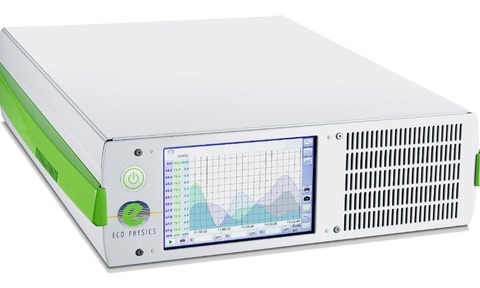
To meet evolving regulations and benefit from NOx tax savings, certified ISO/EN 14792 and 15267-2 instrumentation is essential. Chemiluminescence remains the reference method for measuring nitrogen oxides in stationary emissions. Building on the success of previous models like the CLD 700 ELht, CLD 822Mh, and CLD 822CMhr, Eco Physics introduced the nCLD 800 Series.
These two-channel chemiluminescence analysers measure NO, NO?, and NOx simultaneously across a 5 to 5,000 ppm range, with detection limits from 0.05 ppb to 0.5 ppm. Designed for flexibility, the modular system offers custom features such as dual inlets, parallel gas flow streams, heated lines, dual reaction chambers, metal converters, an internal pump and integrated pressure control for precise emission analysis.
Eco Physics’ solution: nCLD EL2, nCLD 822CMhr
The nCLD EL2 (QAL1 certified) with its heated sample inlet and internal pressure correction allows a specific control of the DeNOx module and the catalyst converter of the nCLD 822CMhr is a very valuable asset to determine the ammonia slip in SCR.
Other applicable industries for nCLD EL2, nCLD 822CMhr:
- Power plants
- Biomass power stations
- CHP (Combined heat and power)
- Waste incineration (municipal, sewage)
- Cement and concrete plants
- Nitric acid plants
Measurement ranges:
Before DeNOx (NO: 500 – 2’000 mg/m3)
After DeNOx (NO: 100 – 500 mg/m3)
SRC NH3 (0 – 10 / 30 ppm)
SNCR NH3 (0 – 50 / 100 ppm)
For more information, click here.
